Saturday, September 05, 2009

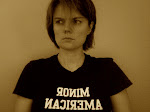
MINOR AMERICAN NUMERO UNO 2009
VANESSA PLACE -- TED POPE -- DES ARK
SEPTEMBER 19, 2009, 8pm
715 Washington Street Durham NC
FREE -- OPEN TO THE PUBLIC -- BYOB

Vanessa Place: Vanessa Place is a writer, a lawyer, and co-director of Les Figues Press. She is author of /Dies: A Sentence/ (Les Figues Press, 2006), /La Medusa/ (Fiction Collective 2, 2008), and /Notes on Conceptualisms/, co-authored with Robert Fitterman (Ugly Duckling Presse, 2009); her nonfiction book, /The Guilt Project: Rape, Morality and Law/ is forthcoming from Other Press. Place is co-founder of Les Figues Press, described by critic Terry Castle as “an elegant vessel for experimental American writing of an extraordinarily assured and ingenious sort.”


Ted Pope:
“I am the warm and fuzzy wall between the Church and The State. Trapped out here in the orbit-of-Mars like a Hound-Dog or an Owl. the little inner buddha is building a wondrous canoe that will travel from my heart... to you.”


Des Ark:
Des Ark is the secret soundtrack of midnight Carolina. It’s the hard and sweet noise of everything that keeps you up at night, a bulldozer come to break its heart with you. Walking alone at night, you can hear Des Ark through the broken window of the used bookstore. Inside, everyone is there and everything is real.




Friday, September 04, 2009

From Coolidge's "The Crystal Text"

A prosewriter's mind's mass is thought plots
but a poet's is fielded of words.

What do you see when you look out with your language?
A pile of hooted buckets.
A loose laugh spoon.
Miles of adroited pain paper.
Lungs full of glass beads.
A list of nodules knowing of nameless.

These are never only things, just, but the words
retracked. Circling as a flying object almost home
with your pen above whatever oval tensions
or the wheat in your litmus class, the glow on the fear.
The witness motions are there. Or add another
e to that th.

Wednesday, July 15, 2009

Thinking Outloud on "Innovation" as a label..

Brian Allen Carr was nice enough to respond to my post in the comments section under the previous post. He makes the point that he was asked to review a book that had "Innovative" stamped on it. Fair enough.

I guess my whole beef is with the narrow understanding of innovation in general. It seems like books in the US are labeled "innovative" or "experimental" where in Germany, for instance, (and only because I am somewhat familiar with German bookstores) these books would simply be called literature. I mean, shouldn't writers always be thinking about whether or not the form they are using is the right one for the 'content' they are working with? In other words, shouldn't anyone writing a novel (or anything for that matter) be thinking about HOW to write it best? The US publishing world favors a certain kind of realist prose, and calls that "fiction" or "literature," and writing that comes out of another kind of literary tradition, if it is not foreign, gets labeled "innovative" or "experimental." These two terms, then, become labels for everything that isn't, for example, Alice Munro and Robert Ford.

To quote the FC2 website: "In his New York Times Book Review "Guest Word" of Sept 15, 1974, Sukenick described the group's aim to 'make serious novels and story collections available' and 'keep them in print permanently.'" In other words, Suckenick and others create FC2 in order to create the possibility of publishing prose other than, to change the old Charles Bernstein term, Official Prose Culture. But I am wondering if we aren't both operating (Carr and I) under a too narrow view of "innovation." The OED defines "innovative: 1. a. The action of innovating; the introduction of novelties; the alteration of what is established by the introduction of new elements or forms. {dag}Formerly const. of (the thing altered or introduced)." It seems like innovative becomes rigid and prescriptive as well: 'did you mess with your sequencing of the narrative? etc.' It seems like a working definition that is more generous to what most writers are doing is the second half of #1: "the alteration of what is established by the introduction of new elements or forms.' Recombinations, in other words. And to toot my own horn, I think I could argue for my work being innovative in this way. I mean, I don't think that Thomas Bernhard ever wrote a lesbian sex scene. If I am wrong on this, let me know. It seems like old technique applied to new content is a kind of innovation.

Sunday, July 12, 2009

I think I don't believe in INNOVATION.


The most negative review my book has received was written by Brian Allen Carr in the March/April 2009 issue of American Book Review online.[By the way, the first long passage that is quoted in the review has a typo in it. The word "site" should be "since."] For Carr, my book's biggest offense besides being "boring" and containing "student-grade prose," was the fact that although The Bruise received the "Ronald Sukenick Innovative Fiction Prize," the book was not "innovative." I can't really defend myself against this charge of non-innovation. That's a question for the judges at FC2. I simply put my manuscript in the mail.

What I mean is that Carr is right when he says that "Marcel Proust, Gertrude Stein, Franz Kafka are all liberally borrowed from here." And that "this is a lesbian pseudo-romance, but that's nothing new." He does forget to mention Thomas Bernhard. I stole like mad from Thomas Bernhard. What I am trying to get to is this: I had no intention of making anything NEW when I was writing this book. In fact, what would or could be new? I am not really interested in that question. It seems like something for boys who like Pynchon and HTML to work on. I was just trying to write a book that I would want to read. My guess is that Carr and I like to read different things. What I find offensive in this review, though, is the implication that I was trying to pull one over on the reader, as if I thought the reader wouldn't hear the imitation, the sampling of my favorites. And this I don't think is Carr's fault. For some reason the literary world is haunted by this idea of novelty. The "Dude, I've heard that before..." syndrome. For all its post-modern claims, it holds tight to the most MODERNIST idea of all: that of making it NEW. But trust me, I was well aware of my book not being new. Charging that my influences are too obvious, both as favorites [as in not obscure enough] and as sounds in the prose, seems like something that would only happen to a writer. I mean, when we hear a Rickenbacker plugged into a Vox on some new indie album, we don't turn it off because it sounds too much like the Beatles. I at least keep listening to see what happens to that Beatles sound. Maybe I am boring, but I don't mind if new music sounds a little like old music. And I like new books that sound a lot like old books that I like. But even if I had lived up to Carr's ideas of the Sukenick award, even if I had completely adopted Sukenick's theories and deviated from linear form by "experimenting" with sequencing, I imagine that I still would have only been as innovative as Tarantino's Pulp Fiction. I would rather be like Bernhard or Proust or Stein, in any case.